

Plastic Waste Pyrolysis Oil Market to Grow from USD 1.84 Billion in 2026 to USD 6.37 Billion by 2035 at 14.8% CAGR
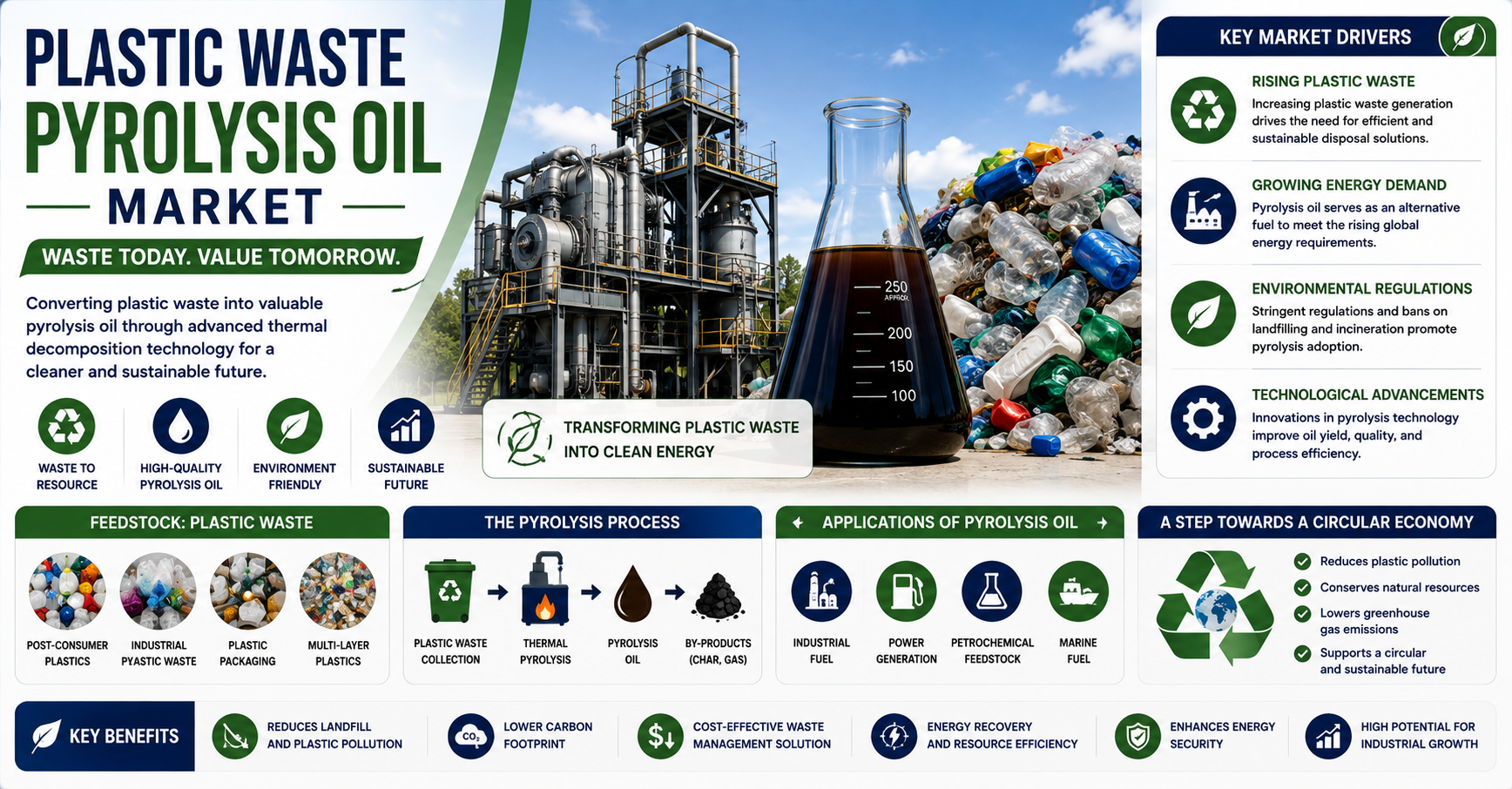
Plastic Waste Pyrolysis Oil Market (2026 - 2035)
North America contributed USD 0.35 billion in 2025, anchored by U.S. state-level advanced recycling statutes.
NY, UNITED STATES, August 6, 2026 /EINPresswire.com/ -- The global plastic waste pyrolysis oil market is undergoing a dramatic transformation. Valued at approximately $1.60 billion in 2025, the market is projected to surge to $1.84 billion in 2026 before climbing to roughly $6.37 billion by 2035, reflecting a robust compound annual growth rate of 14.8%. This acceleration is being driven by a convergence of tightening Extended Producer Responsibility mandates across the EU and OECD nations, breakthrough refinery co-processing approvals that allow pyrolysis oil to displace virgin naphtha in steam crackers, and a wave of public and private capital that has exceeded $4.2 billion in announced project-level investment since 2022.Market Size and Forecast Trajectory
Market Research Future's analysis draws on a triangulated methodology combining bottom-up plant-capacity modeling, top-down trade-flow analysis, and primary interviews with technology licensors, off-takers, and regulatory agencies. Historical figures from 2021 through 2024 reflect audited industry data, while the base year 2025 is estimated from confirmed project pipelines and feedstock availability indices. The forecast through 2035 applies scenario-weighted CAGR modeling calibrated to policy implementation timelines and capital deployment schedules.
The market has grown from $1.13 billion in 2021 and is on a steep upward curve. By 2028, the market is expected to reach $2.43 billion, with momentum building as large-scale facilities move from pilot to commercial operation.
Technology Shift: From Batch Kilns to Continuous Reactors
A fundamental technology shift is reshaping the competitive landscape. Conventional rotary-kiln pyrolysis units, which are capital-heavy, batch-oriented, and typically limited to 40–50% liquid yields, are increasingly giving way to continuous-feed fluidized-bed and microwave-assisted reactors capable of achieving 65–70% oil yields with lower energy inputs. Europe's Innovation Fund committed EUR 1.8 billion to advanced recycling projects in its 2024 call, while Japan's NEDO program allocated ¥32 billion to pilot next-generation catalytic routes. These investments are lowering the cost gap with mechanical recycling and accelerating the transition from pilot to industrial scale.
Get Free Sample Copy: https://www.marketresearchfuture.com/sample_request/32479
Key Growth Drivers
EPR and Recycled-Content Mandates. The EU's Packaging and Packaging Waste Regulation requires plastic packaging to contain at least 10% recycled content from post-consumer waste by 2030, rising to 35% by 2040. This regulatory architecture directly underpins the pyrolysis oil market because chemical recycling is currently the only commercially proven pathway for food-contact-grade recycled polyolefins. The UK Plastic Packaging Tax already levies GBP 217.85 per tonne on packaging with less than 30% recycled content, creating an immediate cost differential that favors pyrolysis-derived feedstock.
Refinery Co-Processing Breakthroughs. Several European refiners, including Preem and Repsol, have secured regulatory clearance to blend up to 5% pyrolysis oil into fluid catalytic cracker feedstock without requiring separate REACH registration. Co-processing slashes the capital requirement for new entrants by eliminating the need for dedicated upgrading units. The U.S. EPA's proposed rule on co-processing advanced recycling outputs could unlock an additional 120,000 tonnes per year of demand by 2028.
Carbon Credit and Emissions Trading Schemes. When replacing virgin naphtha, pyrolysis oil derived from waste plastics can generate up to 2.3 tonnes of CO₂-equivalent credits per tonne of output under the EU ETS. These credits increase revenue by $90–130 per tonne, significantly reducing facility payback periods, with EU Allowance prices averaging EUR 68 per tonne in 2024.
Public Innovation Funding. Europe's Innovation Fund awarded EUR 1.8 billion to large-scale advanced recycling projects in 2024 alone, reducing developer equity requirements by 25–35%. Japan's NEDO program supports microwave-assisted pyrolysis demonstrations with ¥32 billion in grants through 2027. These subsidies de-risk capital deployment and accelerate the market's transition from pilot to industrial scale.
Restraints and Challenges
PAH Contamination. Polycyclic aromatic hydrocarbons remain the most acute technical hurdle. Specification-driven customers, particularly naphtha crackers, impose PAH limits below 50 ppm, yet mixed-plastic pyrolysis oil routinely tests above 200 ppm without dedicated hydrotreatment. Adding downstream purification raises operating costs by $40–80 per tonne, eroding the margin advantage over virgin feedstock and slowing commercial qualification timelines.
High Capital Intensity. A commercial-scale pyrolysis plant processing 20,000 tonnes of plastic waste per year typically requires $35–60 million in total installed capital. For developers in emerging markets with limited access to project finance, this intensity constrains the market to regions with strong public co-funding mechanisms. Modular plant designs are beginning to lower the entry threshold, but financing remains a gating factor in South America and parts of Africa.
Feedstock Quality Variability. Mixed post-consumer plastic waste varies widely in composition, moisture content, and contamination levels. Plants fed with inconsistent waste streams experience yield fluctuations of 10–20%, undermining production planning and offtake contract compliance. Standardized feedstock pre-processing protocols are still evolving, particularly in regions without mature waste-sorting infrastructure.
Competition from Mechanical Recycling. Mechanical recycling remains the lower-cost option for clean, mono-material streams. Pyrolysis oil must compete for feedstock and market share, particularly in Europe and North America where collection infrastructure for mechanical recycling is well-developed.
Crude Oil Price Volatility. Because pyrolysis oil pricing is often benchmarked to Brent crude plus a green premium, volatility in global oil markets creates revenue uncertainty and can compress margins during low-oil-price environments.
Segment Analysis by Raw Material
Waste Plastics commanded a 63.0% share of the market in 2025, driven by EPR-linked collection mandates and refinery offtake agreements. This segment reflects the convergence of high feedstock availability, with over 350 million tonnes of plastic produced globally in 2024, and binding recycled-content regulations. Mixed polyolefin streams, particularly polyethylene and polypropylene from post-consumer packaging, constitute the primary feedstock, though PET and polystyrene streams are gaining traction as sorting technologies improve.
Waste Tires are expanding at a 15.4% CAGR through 2035, supported by tire-derived fuel standards and landfill diversion policies. An estimated 1.5 billion end-of-life tires are generated annually worldwide, and landfill bans in the EU and over 30 U.S. states channel this waste toward thermal recovery. Tire-derived pyrolysis oil yields tend to be more consistent than mixed-plastic streams, offering operational advantages that appeal to fuel-market buyers.
Biomass-based pyrolysis oil is valued at $0.16 billion in 2025, serving niche biorefinery applications and renewable fuel credit markets.
Segment Analysis by Application
Fuels accounted for 87.3% of the market size in 2025, reflecting demand for low-sulfur marine fuel and refinery co-processing feedstock. Fuel-grade oil requires minimal upgrading compared to chemical-grade specifications. Refinery co-processing and marine bunker blending together account for the majority of current offtake.
Chemicals are growing at a 16.8% CAGR as petrochemical producers pursue recycled-content naphtha for polymer production. While this segment is smaller today, it represents the highest-value opportunity. Achieving the required purity levels demands additional hydrotreatment investment, but the premium pricing justifies the capital outlay for integrated producers.
Report Summary: https://www.marketresearchfuture.com/reports/plastic-waste-pyrolysis-oil-market-32479
Regional Landscape
Europe dominates the market with an estimated 36.2% revenue share in 2025, backed by the EU Packaging and Packaging Waste Regulation and mandatory recycled-content targets for food-contact polymers. Germany leads the region with 22.4% of the European share, supported by a strong dual-system collection infrastructure and BASF's ChemCycling program, which alone committed EUR 500 million to integrated pyrolysis-to-polymer value chains. The UK is growing at a 15.8% CAGR, driven by the Plastic Packaging Tax. The Netherlands benefits from its port-refinery corridor offering co-processing scale. Europe's leadership reflects two decades of policy layering, from the Waste Framework Directive to the 2025 PPWR enforcement timeline.
North America holds the second-largest position, contributing $0.35 billion in 2025. The United States anchors the region with 78.5% of the North American share, supported by state-level advanced recycling legislation in 24 states that classify pyrolysis as manufacturing rather than waste disposal, accelerating permitting timelines. Texas and Ohio host the largest announced facilities, each exceeding 30,000 tonnes per year of mixed-plastic intake capacity. Canada is growing at a 12.3% CAGR under its federal plastic-pollution prevention framework.
Asia-Pacific is the fastest-growing region at a 16.3% CAGR, fueled by rapid capacity build-outs in China and India. China accounts for 31.5% of the regional share, reflecting its post-National Sword pivot to domestic advanced recycling. India is expanding at an 18.4% CAGR, driven by EPR framework enforcement under Plastic Waste Management Rules that now cover over 10,000 brand owners. Japan contributes $0.08 billion, with ENEOS and Idemitsu refineries committing to integrate pyrolysis oil into cracker feedstock. South Korea is growing at 15.9% CAGR, supported by K-ETS carbon credit incentives.
South America holds a 7.0% revenue share, with Brazil dominating at 68.2% of the regional market. The country's National Solid Waste Policy incentivizes advanced recycling through tax credits, and its cooperativa-based collection system provides low-cost mixed-plastic feedstock. Argentina is growing at a 14.6% CAGR as its petrochemical sector seeks alternative feedstocks.
Middle East and Africa contributed $0.11 billion in 2025. The region remains heavily centered on petrochemical giants exploring circular-economy portfolios. Saudi Arabia leads with 28.3% of the regional share through SABIC's TRUCIRCLE initiative and Aramco's investment in Plastic Energy's Netherlands facility. The UAE is growing at a 17.2% CAGR, leveraging its Jebel Ali petrochemical hub for diversification. South Africa and Egypt are emerging markets with nascent EPR legislation and waste-to-value infrastructure grants.
Buy Now Copy: https://www.marketresearchfuture.com/checkout?currency=one_user-USD&report_id=32479
Competitive Landscape
The market exhibits medium concentration, with the top five players holding an estimated 32–38% combined revenue share in 2025. The Herfindahl-Hirschman Index falls in the 800–1,200 range, characteristic of a market transitioning from fragmented pilot-stage ventures toward consolidated industrial operations. Competition centers on technology licensing, feedstock sourcing agreements, and downstream offtake partnerships rather than price alone.
Plastic Energy leads with an estimated 7–10% revenue share, leveraging its patented TAC process for mixed plastics and pioneering food-grade recycled oil through partnerships with SABIC and ExxonMobil.
Brightmark holds approximately 5–8% of the market, pursuing a vertically integrated feedstock-to-fuel model with large-scale U.S. pyrolysis plants. In January 2025, Brightmark secured $680 million in project finance for its Ashley, Indiana mega-facility, representing the largest single-site investment in North American advanced recycling.
Agilyx commands roughly 4–7% of the market with a differentiated single-polymer approach focused on polystyrene depolymerization. In June 2024, the company completed commercial commissioning of its Tigard, Oregon unit, achieving 90% styrene monomer recovery at steady-state operations.
Quantafuel holds an estimated 3–6% share, operating continuous catalytic pyrolysis from its Scandinavian hub with BASF offtake agreements.
New Hope Energy accounts for approximately 3–5% of the market, pursuing a scale-focused strategy targeting refinery co-feed from its high-capacity Texas facility.
Nexus Circular represents roughly 2–5% of the market with a franchise-style modular deployment model for distributed small-scale plants.
Klean Industries captures about 2–4% as a technology licensor across Asia-Pacific for both tire and plastic pyrolysis systems.
Alterra Energy holds approximately 2–4% through its patented polymer-to-fuel technology and partnership with Neste for renewable diesel blending.
Pyrowave accounts for 1–3% with its microwave-assisted depolymerization approach focused on polystyrene-to-styrene monomer recovery.
Encina Development Group holds roughly 1–3% with an aromatics-focused circular chemistry model. In December 2023, Encina closed a $1.1 billion financing package for its Point Comfort, Texas facility designed to convert 450,000 tonnes of mixed plastics into BTX aromatics annually.
Other notable developments include ENEOS Holdings' April 2024 announcement of co-processing trials integrating 3,000 tonnes of pyrolysis oil annually into its Negishi refinery FCC unit in Yokohama, Japan.
Similar Report
tire pyrolysis oil market https://www.marketresearchfuture.com/reports/tire-pyrolysis-oil-market-30537
recycled plastic and plastic waste to oil market https://www.marketresearchfuture.com/reports/recycled-plastic-and-plastic-waste-to-oil-market-30724
Liquid Waste Management Market https://www.marketresearchfuture.com/reports/liquid-waste-management-market-8345
biological wastewater treatment market https://www.marketresearchfuture.com/reports/biological-wastewater-treatment-market-9427
precious metals e waste recovery market https://www.marketresearchfuture.com/reports/precious-metals-e-waste-recovery-market-25209
Market Research Future
Market Research Future
+1 855-661-4441
email us here
Legal Disclaimer:
EIN Presswire provides this news content "as is" without warranty of any kind. We do not accept any responsibility or liability for the accuracy, content, images, videos, licenses, completeness, legality, or reliability of the information contained in this article. If you have any complaints or copyright issues related to this article, kindly contact the author above.
